Golden Knights' Long-Range Volume Is High, but the Points Aren't Sinking Them
Vegas fires from everywhere, but its high-danger volume and the numbers from the points tell a more nuanced story about its shot selection.
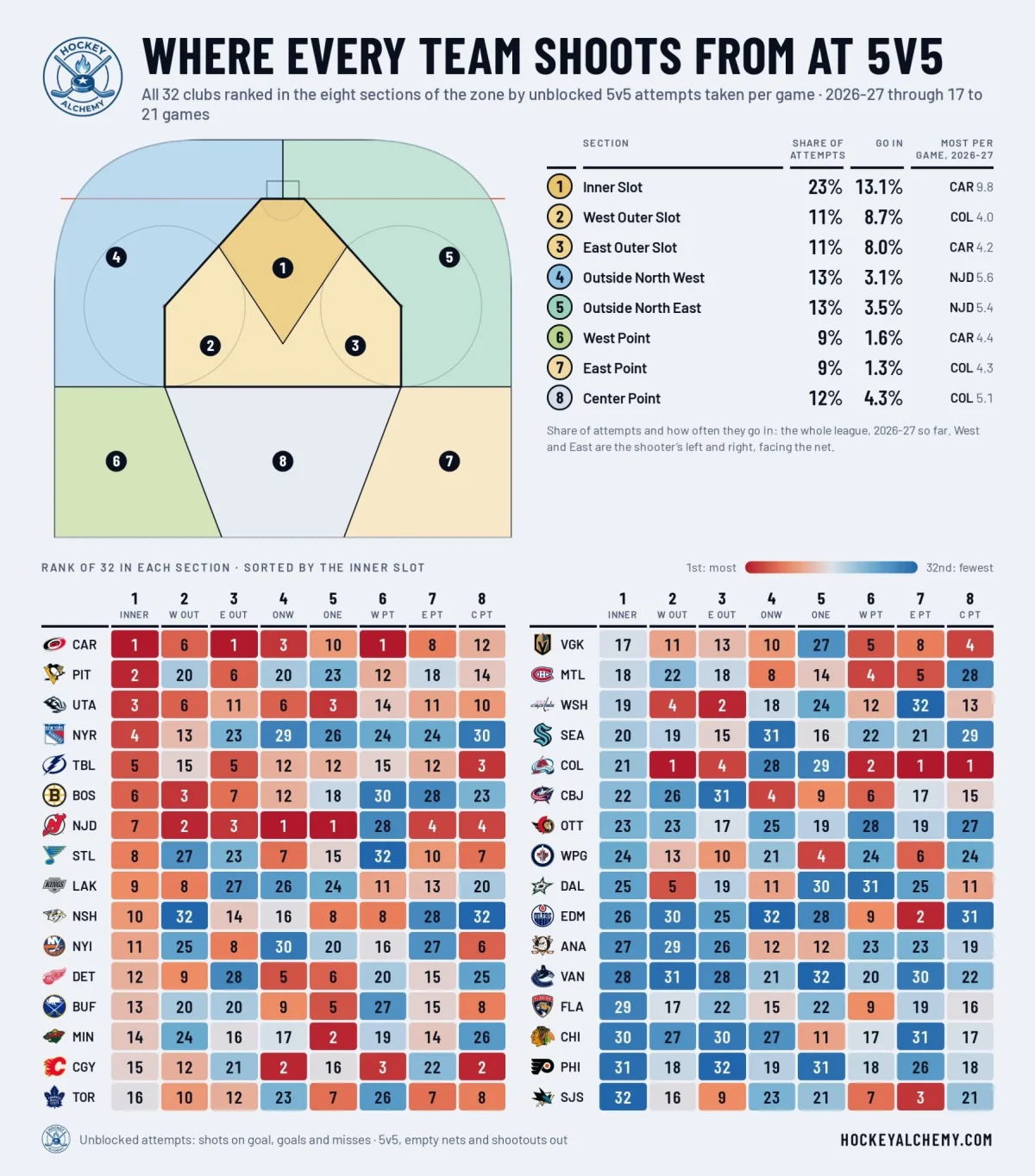
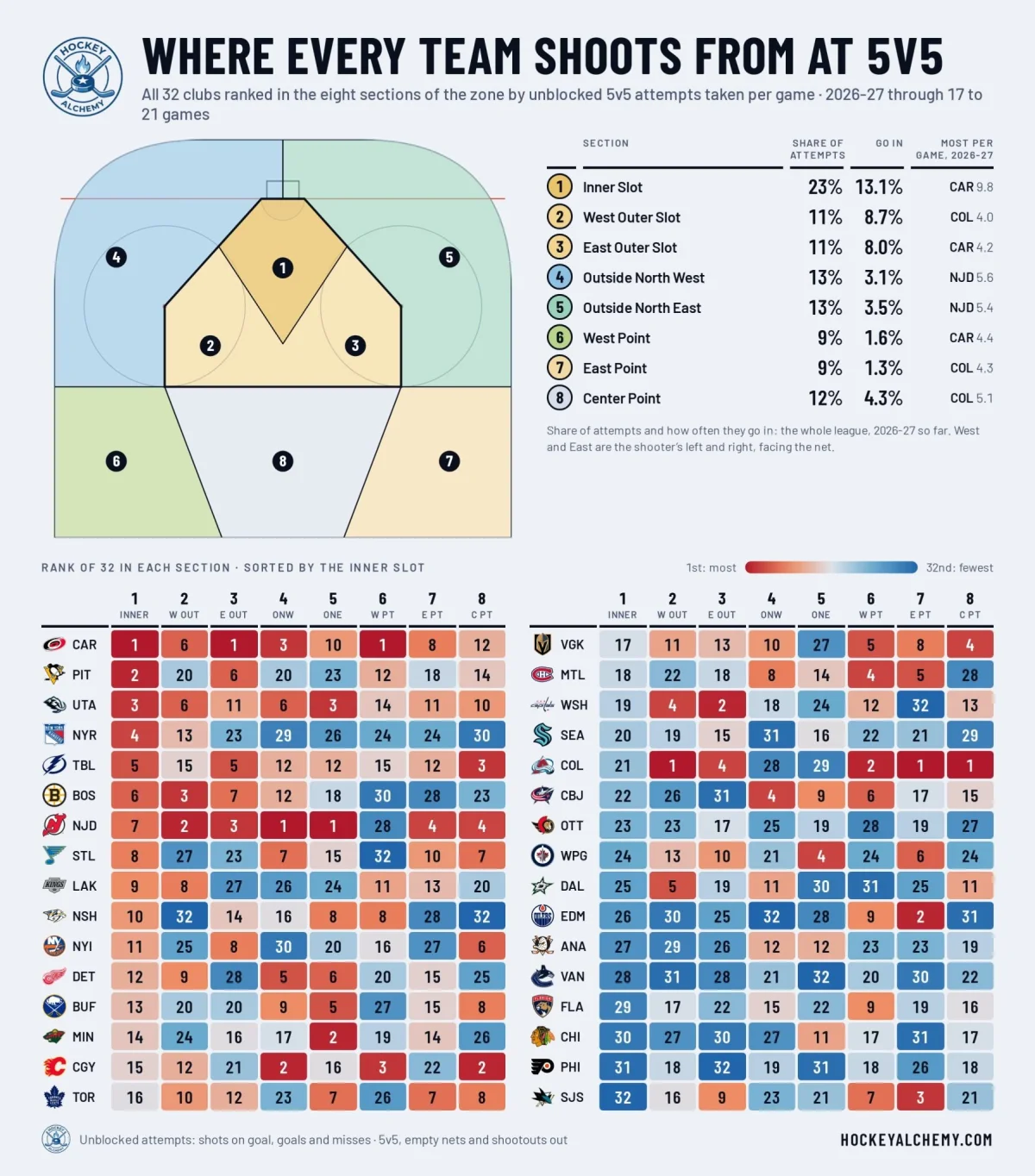
A shot-location chart from HockeyAlchemy.com made me look twice at Vegas's offense. At a glance, a big chunk of the Golden Knights' attempts seem to come from the outside, and the point shots stand out. The question is whether that's a problem or just a style.
Where the shots are coming from
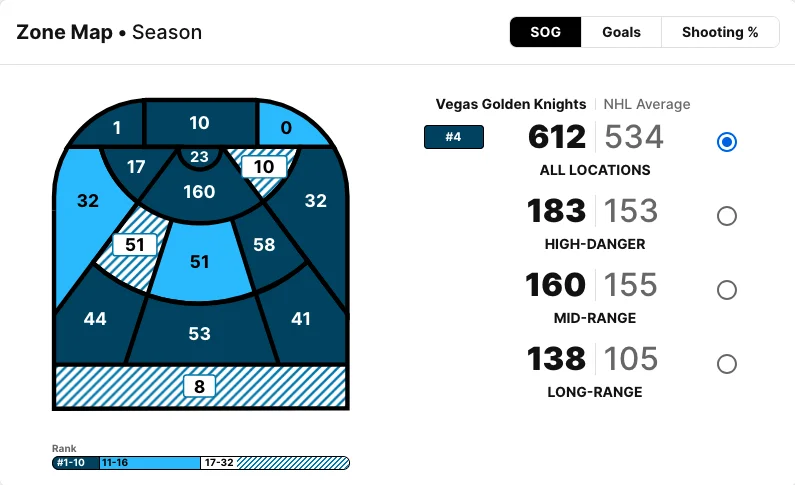
The Hockey Alchemy chart ranks teams by unblocked shot attempts per game across eight zones of the ice. Vegas's best rankings sit at the points, which is what first made me wonder whether the team was relying too heavily on distance. The NHL Edge breakdown, which covers all shots rather than just 5-on-5, tells a similar story with a slightly different map.
By the eight-zone breakdown, the inner slot leads with 183 shots (31.3%). The outer slots follow with 77 from the west side (13.2%) and 83 from the east (14.2%). The points account for the rest of the distribution: 55 from outside northwest (9.4%), 47 from outside northeast (8.1%), 44 from the west point (7.6%), 41 from the east point (7.0%) and 53 from center point (9.1%).
Edge collapses those zones into three buckets. High-danger registers 183 shots (31.4%), mid-range 160 (27.4%) and long range 138 (23.7%). There's no getting around it: this group is willing to put pucks on net from almost anywhere on the ice. That part of the chart isn't in dispute.
Where the goals are actually coming from
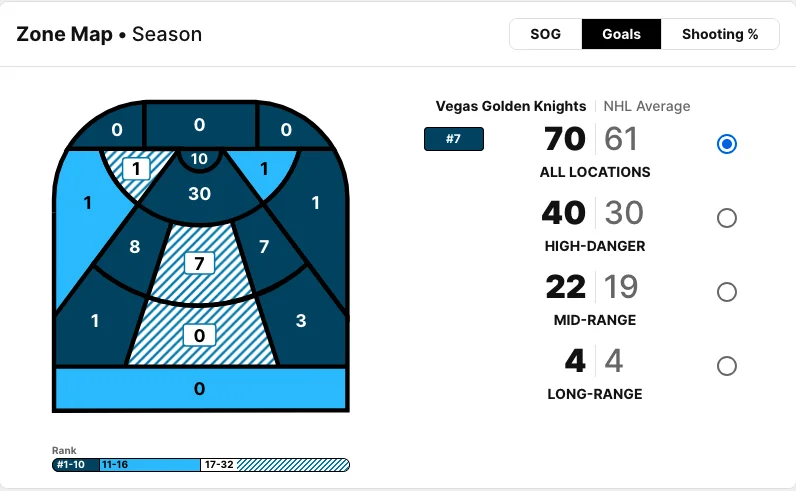

Volume is one thing. Conversion is where the real discussion starts, and this is where Vegas's profile gets interesting. The Golden Knights lead the league in goals scored directly in front of the net with 40, tied with Carolina, though Carolina has played one fewer game. That's the kind of finishing you'd expect from a team that owns the crease.
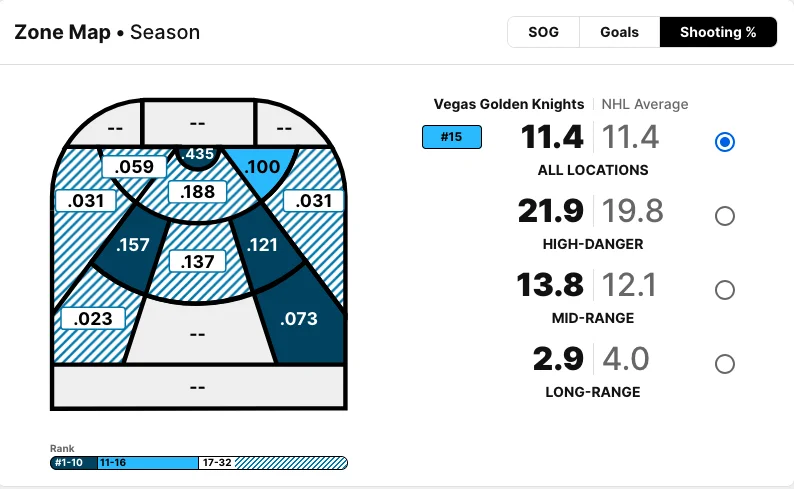
The shooting percentage in the high-danger area is a different story. At 21.9%, Vegas ranks 10th in the league, which is good but not elite given how many chances it generates there. The slot is the sharper concern. When the puck sits in the slot but not in the crease, Vegas converts just 18.8%, a number that places it in the bottom third of the NHL. That's where I'd expect the coaching staff to be looking for improvement, because it's the zone where a small shift in finishing turns into a lot of goals.
The point shots: a split decision
Once the puck moves back toward the blue line, the percentages get noisy. Counting every long-range attempt, Vegas sits at 2.9%, which ranks 23rd. That's the number that makes the volume look wasteful on paper. Yet the zone-by-zone splits are wildly uneven. The east point is the league's best at 7.3%, while the west point is at 2.3%, one of the weakest marks in the league. Those are big swings for areas of the ice that are roughly the same distance from the net.
The center point is the most eye-catching case. It accounts for 9.1% of Vegas's shots, yet the team hasn't scored a single goal from there this season. A 53-shot sample with zero goals is a lot of pucks without a payoff, and it's worth watching whether it's bad luck, a shot-quality issue or simply a sign that the shooters should be looking for a pass or a screen.
Overall team shooting sits at 11.4%, which is right in line with the league average. Vegas isn't an outlier in its results, even if its shot diet looks unusual.
Tips, deflections and the bigger picture
The conventional wisdom is that a team leaning on long shots bleeds possessions unless it's excellent at tips and deflections. Vegas isn't in that category. The team has 40 tip shots (T-17th), six tip goals (T-13th), nine deflection shots (T-13th) and three deflection goals (T-3rd). Those numbers suggest the tip game is competent but not the engine of the offense.
And that's what makes this surprising. Vegas has scored just 13 goals from long range or off tips and deflections combined, and it still ranks first in high-danger goals and fourth in high-danger shots. It's still generating 31.3% of its attempts from the inner slot even while nearly leading the league in long-range volume. The point shots haven't come at the expense of quality chances, which runs counter to what I expected to find.
Here's the thing, though: Vegas takes a larger share of its shots from long range than the average NHL team, but its share from the high-danger area is above average too. That's the combination that usually signals a team is doing two things well at once. The point shots aren't the reason the offense is working, and they aren't the reason it's stalling either. They're a feature of the system that the team can lean on when the middle of the ice is clogged.
The open question for the rest of the season is conversion. If the slot finishing rises toward the league median and the center point starts producing even occasionally, the current shot mix will look like a strength rather than a warning sign. If the slot numbers stay in the bottom third, the volume from the points will start to matter a lot more. And if those point shots begin finding the net at a higher clip, well, now imagine what this offense looks like.