Shea Theodore’s Shot Volume and Defensive Work Lift Vegas’ Blue Line
Theodore is blocking more shots and firing more often, giving Vegas a bigger two-way presence through its first seven games.

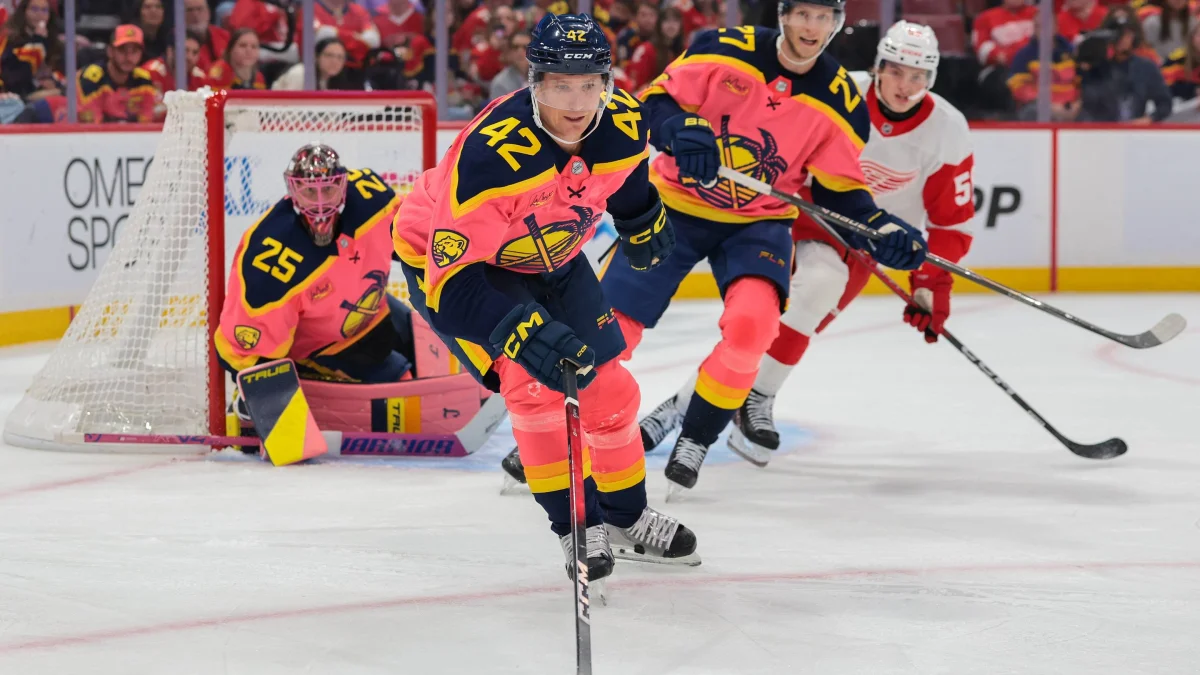
(Photo Credit: SinBin.vegas Photographer Brandon Andreasen)
Shea Theodore is making his presence felt at both ends of the ice for Vegas, and two early-season trends help explain why. The Golden Knights’ top defenseman is stepping into more shooting lanes and putting more pucks on net than he did last season. Across seven games, that combination has made him a steady influence in his own zone and a more frequent source of offensive pressure.
Theodore leads Vegas in average ice time at 21:45 per game. He has blocked 10 shots, second on the team, and his plus-seven rating is also the club’s second-best mark. His 16 shots on goal rank fourth among Golden Knights skaters, while his three points are tied for ninth. The point total is modest so far; the workload and activity around it are the more telling parts of his start.
More work in the shooting lanes
Theodore has never led his team in blocked shots during his NHL career, but he has already made a habit of getting in front of opposing attempts. His 10 blocks through the opening stretch put him on pace for 120 over a full season. That would top his previous high of 97, set in 2021-22, by 23.
His recent totals show that this isn’t a role he has ignored. Theodore recorded 82 blocked shots in 2022-23, 78 in 2023-24, 82 in 2024-25 and 95 last season. The current pace would represent a substantial jump from each of those campaigns, even as his average ice time already places a significant defensive load on him.
- 2021-22: 97 blocked shots
- 2022-23: 82 blocked shots
- 2023-24: 78 blocked shots
- 2024-25: 82 blocked shots
- 2025-26: 95 blocked shots
- 2026-27: on pace for 120 blocked shots
That projection deserves the usual early-season caution: seven games are a small sample, and a full year of shot-blocking can test a defenseman’s willingness to absorb attempts. Still, the behavior is already visible. Theodore has put his body in shooting lanes repeatedly, adding a defensive detail to a game that is often measured by his puck-moving and offense.
There’s a team angle, too. Brayden McNabb has long been a prominent shot blocker for Vegas, taking on the physical cost that comes with that work. If Theodore continues to shoulder more of those attempts, it could spread some of that burden across the defense. The early numbers don’t establish how the workload will hold up, but they show a meaningful change in Theodore’s contribution.
A more active shooting threat
Theodore’s increased shot volume is the other clear signal. He has already reached four shots on goal in two games. Last season, he hit that mark only nine times in 70 appearances. Even in his most recent game, when he finished with one shot on goal, he recorded seven attempts, matching his season high.
- 2021-22: 205 shots on goal
- 2022-23: 136 shots on goal
- 2023-24: 105 shots on goal
- 2024-25: 128 shots on goal
- 2025-26: 130 shots on goal
- 2026-27: on pace for 210 shots on goal
A 210-shot pace would bring Theodore close to his 205-shot total from 2021-22 and well above his output in each of the past four seasons. The pace is an estimate built from a short run of games, not a prediction that he’ll necessarily finish there. What matters for Vegas now is that he’s finding more chances to send the puck toward the net.
Those attempts can create offense without Theodore scoring directly. A shot from the point can produce a deflection, a rebound, or a stoppage that gives Vegas an offensive-zone faceoff. Those plays are especially useful when a team is generating pressure but hasn’t found a clean route through traffic. Theodore’s shot has helped create those situations before; the difference so far is how often he’s getting the opportunity to use it.
Throwback to Shea Theodore scoring the first playoff goal in Vegas Golden Knights history pic.twitter.com/Si3Tv1VlL1
— Daily Faceoff (@DailyFaceoff) May 27, 2026
Blue-line offense joins a balanced start
Vegas has had contributions throughout its lineup, with 13 different skaters scoring and the top six accounting for 10 of the team’s 24 goals. The defense has added three goals in seven games, including Rasmus Andersson’s goal in Minnesota. Theodore’s willingness to shoot gives the blue line another way to support that offense, even when the final play belongs to a teammate or the result is simply sustained pressure.
He isn’t being asked to carry Vegas’ scoring. His three points sit tied for ninth on the team, and the Knights have other players producing goals. But his value goes beyond that column: he is logging the club’s highest average ice time, ranking near the top in blocks and plus-minus, and producing shots at a pace that could approach a career high.
For Vegas, the useful takeaway is the balance in Theodore’s start. He is taking on defensive work while making himself a more frequent part of the attack. If those habits continue, the Knights will have a top defenseman who can affect possession, limit opposing chances and help manufacture offense from the point.