Capitals Top Penguins 5-3 as Ovechkin Opens His Final Washington Home Season
Tom Wilson’s three-point night and a perfect penalty kill led Washington past Pittsburgh, while Ryan Leonard scored on the power play.
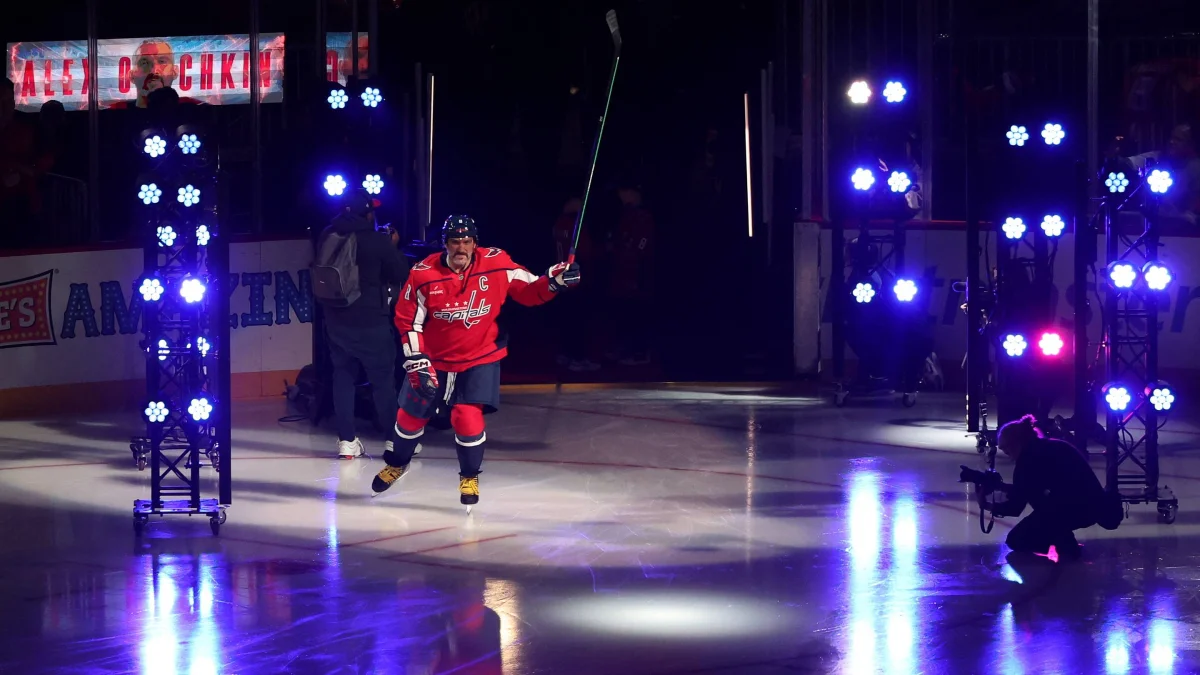
Washington’s 5-3 win over Pittsburgh had a fitting backdrop: Alex Ovechkin’s final Capitals home opener, with Sidney Crosby and the Penguins in the building. The night also offered a clear view of how this team can win when its captain isn’t carrying the attack. Tom Wilson’s line drove the offense, Ryan Leonard struck on the power play, and the penalty kill shut Pittsburgh out across three chances.

Ovechkin did not record a point. He was on the ice for the game’s opening goal, though, as Dylan Strome found Anthony Beauvillier breaking forward and Beauvillier scored 23 seconds into the first period. That quick strike set the pace for a game in which Washington got contributions from across its lineup rather than leaning on one familiar source.
Wilson’s line sets the tone
Wilson, Alex Tuch and Pierre-Luc Dubois combined for seven points: Wilson had a goal and two assists, Dubois finished with a goal and an assist, and Tuch scored once. Their production was the headline, but the way the trio can be used may matter just as much over a full season. They bring size, speed and finishing ability, while offering Washington a line that can take difficult matchups against opposing top players.
That combination gives the Capitals several ways to make a shift uncomfortable for a defense. The line can attack with the puck, pressure opponents physically and still provide scoring. A single performance can’t establish how consistently that balance will hold, but this was a strong early example of the matchup problem Washington hopes the trio can create.
It also changes the workload around the rest of the forward group. When one line can threaten in more than one situation, opponents have less freedom to focus their toughest matchups on a single scoring unit. Washington’s depth gives coach Spencer Carbery options to spread out capable players and keep pressure coming beyond the top line.
Depth gives Washington more lineup options
Leonard skated with Justin Sourdif and Boone Jenner in a group described as Washington’s fourth line. That label may understate the unit’s potential. The three forwards were presented as players who could fit into a third-line role on many teams, a sign of the depth the Capitals believe they have up front.
There’s a practical benefit to that distribution. If a lower line can contribute meaningful minutes and keep opponents occupied, the top players don’t have to shoulder every difficult shift. Washington can rotate its forwards through matchups and maintain pressure through more of the lineup. The next test is whether those options remain effective as the season develops; one game doesn’t answer that, but it does show the range the roster can offer.
Leonard supplied another tangible return with his second goal of the season, and his third-period power-play strike was Washington’s only goal in four opportunities with the extra skater. The one-for-four result leaves room for improvement, but converting once matters for a unit described as having struggled for an extended stretch. If that production continues, the power play could give the Capitals another route to offense when five-on-five scoring tightens.
Special teams and the next test
The penalty kill was the steadier special-teams unit against Pittsburgh. The Penguins went zero for three, extending a strong early run for Washington’s shorthanded group. After three games, the Capitals’ penalty kill stood at 91.7%, according to StatMuse. That figure is an early-season snapshot, but the immediate result was clear: Pittsburgh did not turn its power-play chances into goals.
Tuch’s value reaches beyond his goal. The source identifies him as a top penalty killer, giving Washington a forward who can contribute at both ends of special teams. If the penalty kill maintains this level, it can help the Capitals manage games when penalties interrupt their rhythm. Leonard’s power-play finish, meanwhile, offered a sign that the other unit may be finding a foothold.
For Ovechkin, the opener was a milestone night without a point on the scoresheet. The larger team story was the support around him: Beauvillier opened the scoring, Wilson’s trio supplied the bulk of the listed production, Leonard finished a power-play chance, and the penalty kill denied every Pittsburgh opportunity. That spread of contributions is a more useful early indicator of Washington’s shape than expecting its captain to lead every offensive moment.
The Capitals’ next opponent is the Rangers, with Washington back at Capital One Arena on Friday. The matchup will offer another look at whether the Wilson line can sustain its impact and whether the special teams can keep backing it up. For now, the 5-3 result gives the Capitals an encouraging blueprint: depth up front, timely power-play scoring and a penalty kill that held firm against a division rival.