Mikhail Yegorov’s 34 Saves Set Up BU’s Overtime Comeback Win Over Maine
Mikhail Yegorov stopped 34 shots as BU erased a 2-0 deficit, beat Maine 3-2 in overtime and took five of six weekend points.

Boston University’s comeback says as much about its goaltending as its finish. The No. 14/13 Terriers were outplayed for long stretches by No. 19 Maine, but Mikhail Yegorov kept the deficit manageable before BU rallied for a 3-2 overtime win and five of six weekend points. That’s a satisfying result, but the route to it matters: BU needed its goalie to hold the game together before its offense could change it.
Yegorov made 34 saves, including 19 in the first period. Maine outshot BU 21-8 in that frame, won most of the board battles and repeatedly drove toward the crease. A shot count can’t explain every chance, but that imbalance points to a period in which Maine controlled more than the puck. The Black Bears were getting to dangerous areas and making BU defend repeated sequences. The instinct is to focus on BU’s late offense; the bigger story is that the Terriers survived a first period in which they could easily have fallen further behind.
Maine built its lead at the net
The Black Bears opened the scoring at 5:37 after forcing a turnover behind the BU goal. Rowan Calvert poked in a loose puck with two forwards and a defenseman arriving in front. The goal reflected the pressure Maine was applying: a defensive-zone mistake became a scramble in the most dangerous part of the ice, and several Black Bears were close enough to compete for the puck.
At 14:45, Lee Parks sent the puck from the left boards to Max Scott, left open between the circles, and Scott beat Yegorov under the crossbar. That chance was different from the first goal. Maine moved the puck into the middle and found a shooter with room to finish, the kind of opening that can punish a team whose coverage has started to stretch under pressure. Yegorov couldn’t be expected to erase every breakdown in front of him.
BU had a shorthanded two-on-one chance, but Caleb Malhotra’s pass to captain Jack Harvey landed in Harvey’s skates. It was a brief opening for the Terriers to change the feel of the game, and the failed connection left Maine with the stronger share of the first-period play. Those moments don’t decide a game on their own, but they help explain why BU entered the third chasing two goals.
Maine took a 2-0 lead into the third after controlling the pace and generating repeated Grade A chances. Yegorov’s first-period work included a breakaway stop and 10 saves across three Maine power plays. The power-play saves mattered because special teams can magnify a team’s territorial advantage: a club already spending time in the attacking zone gets another chance to settle in and attack. Yegorov kept that pressure from turning into a larger lead.
Yegorov gave BU room to recover
A goalie’s contribution in a comeback can be easy to understate. The final score records the saves and goals, but it doesn’t show the effect of stopping a breakaway or keeping a power play from producing another goal. Here, Yegorov’s work meant BU remained within reach even while Maine had the better of the early exchanges. The margin was still two, and the Terriers still had to create offense, but the game hadn’t slipped beyond their grasp.
This is more significant than it looks. A team that’s being outshot and losing board battles can start forcing plays in an effort to catch up, which risks giving the opponent even more chances. BU had to resist that pull and find a way back into the game without treating every possession as an emergency. Its comeback depended on both sides of the equation: Yegorov’s stops and the forwards’ ability to make their opportunities count.
BU found its answer late
Tynan Lawrence scored twice in the third, once on the power play and once off the rush, to pull BU even. The two goals came through different kinds of offense. One came with the man advantage; the other came in transition. That variety matters because a team that can only score in one setting may find its options narrow when an opponent adjusts or keeps play away from that situation.
Then Malhotra supplied the overtime winner with a highlight-reel finish, earning the extra standings point. Overtime gives a close game a sharp ending, but the winner doesn’t erase the uneven stretches that came before it. BU had to come back from two down, and the late finish speaks to its ability to respond under pressure. It also leaves the team with a clear question: can it generate enough at five-on-five before a game reaches that stage?
BU had opened the weekend with three very early goals Friday. Saturday required a different kind of response: its forwards had to convert, and Yegorov had to keep giving them time. Five of six weekend points is a useful return, though the two games tested the team in different ways. A quick start can put an opponent on its heels; a two-goal comeback asks whether a team can stay composed after falling behind.
The next test is sustaining the response
If you’re tracking the Terriers, the question is whether they can carry that late-game resilience into stretches when they don’t have their goaltender under such pressure. Yegorov’s performance is a strength to take from this game, but relying on a goalie to withstand repeated chances is a demanding way to win. BU will want the offense from Lawrence and Malhotra, while also tightening the defensive work that allowed Maine to control the opening period.
And yet, the comeback does count. BU found two goals in the third and finished the job in overtime, evidence that its deficit didn’t dictate its response. The honest read is mixed: a strong finish and a valuable result, earned after a first period that gave Maine too much room. For a team looking to build on the weekend, both parts deserve attention.
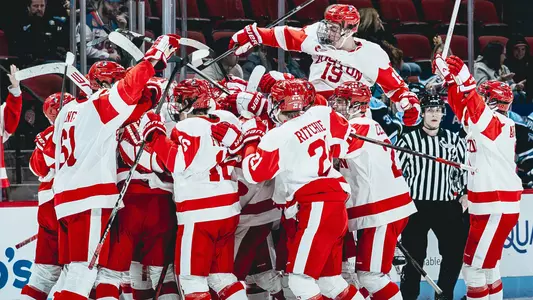
Photo credit Katie Peverada. The image captures the celebration after BU’s overtime win, while the game itself turned on the saves that kept the comeback possible.
Pandolfo post-game begins at 3:43. His post-game comments offer a place to hear the coach’s immediate reaction to a game that changed sharply between the opening period and overtime.
YouTube College Hockey Network has extended highlights of BU-Maine and other games. The site is also linked in the sidebar Links section, giving viewers a way to revisit the goals and key sequences from the game.